

Today’s buying journeys rarely follow a straight line. A prospect might discover a brand through a digital ad, research options on their phone, receive a mailpiece at home, and ultimately convert online days later.
The challenge for many marketers isn’t a lack of channels or data. The challenge is coordination.
Campaigns often move too slowly. Channels operate in silos. Follow-up arrives after the moment of intent has already passed.
When execution lags, opportunity disappears.
Modern campaigns must perform across all channels, with each touchpoint reinforcing the next. Direct mail plays a unique role in this process. A personalized mailpiece creates a tangible moment of engagement, while digital channels reinforce the message and guide the recipient toward action.
The key is timing. When mail, digital engagement, and data-driven triggers move together, brands stay present during the decision window — not after it has closed.
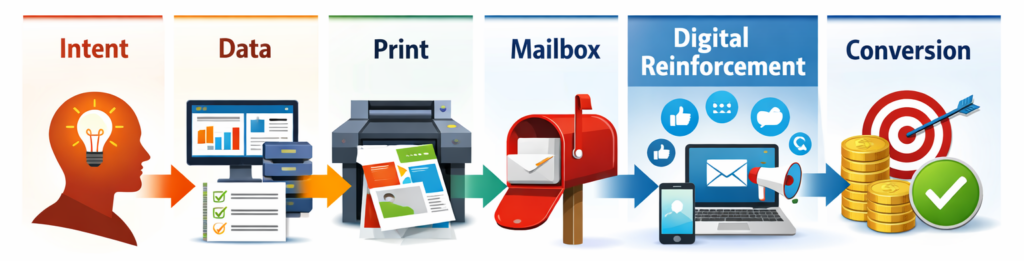
Modern buying journeys move quickly. When a prospect shows intent—by visiting a website, downloading content, or researching a product—the window to respond is often short.
Many campaigns miss that window because production cycles move too slowly. Data is gathered, approvals take time, files are processed in batches, and by the time mail reaches the mailbox, the moment of intent has already passed.
The brands that win are the ones that act while intent is still active.
Trigger-based mail programs make this possible. When customer activity generates a signal, qualified data can move directly into production, enabling personalized mail to be printed and deployed without delay.
Daily data intake, rapid personalization, and coordinated mail entry allow campaigns to respond in real time—keeping brands visible while prospects are still making decisions.
In this environment, speed to mailbox has become just as critical as speed to inbox.
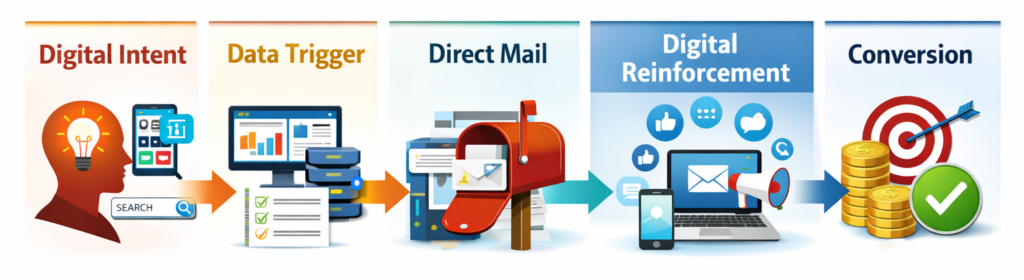
When direct mail is engineered to move quickly and connect with digital touchpoints, it becomes a powerful trigger for coordinated engagement across channels.
• Intent is identified
Customer activity such as website visits, content downloads, or product research signals interest.
• Data flows directly into production
Qualified prospect data moves quickly into campaign workflows without unnecessary delay.
• Personalized mail is deployed quickly
Targeted postcards or letters are printed and entered into the mailstream while intent is still active.
• QR codes and PURLs connect recipients to digital experiences
Mail pieces link directly to personalized landing pages, creating a seamless bridge between physical and digital engagement.
• Digital channels reinforce the message while mail is in-home
Email, paid social, and display campaigns increase visibility while the mailpiece is arriving and after it lands.
• Engagement is measured end-to-end
Performance data across channels provides clear attribution and insight for campaign optimization.
Many marketing providers talk about integrating direct mail with digital channels, but few are structured to execute it at speed.
Traditional production models often rely on fragmented workflows. Data processing, printing, finishing, mailing, and digital activation are handled by separate vendors, introducing delays at every stage.
Common barriers include:
• Fragmented vendor ecosystems
Campaigns rely on multiple vendors, slowing down execution and coordination.
• Outsourced finishing and mail preparation
Additional handoffs introduce time delays and limit flexibility.
• Postal strategy applied too late in the process
Postal optimization is often treated as a final step rather than a strategic input.
• Digital engagement disconnected from physical campaigns
Without coordinated timing, digital reinforcement arrives too early—or too late—to influence behavior.
When these elements operate in silos, campaigns lose momentum and miss the critical window when consumer intent is highest.
Delivering coordinated engagement across channels requires a production environment built for speed, data integration, and visibility.
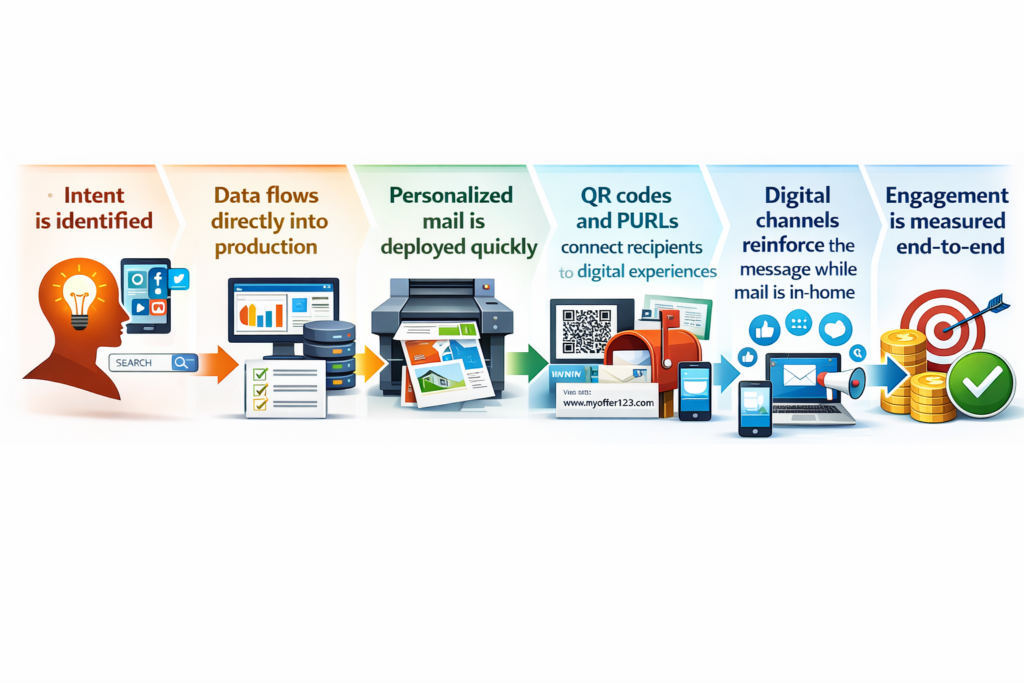
At American Litho, this execution depends on five core capabilities:
• Daily data intake and decisioning
Customer activity signals can be captured and acted on quickly.
• High-speed personalization at scale
Modern digital print technology allows each mailpiece to be uniquely targeted.
• In-house finishing and mail preparation
Controlling finishing and mail prep internally eliminates delays and ensures precision.
• Postal intelligence embedded early in production
Postal strategy is integrated into the campaign design, improving delivery speed and reducing costs.
• Visibility from production through response
Marketers gain insight into campaign progress, delivery timing, and engagement performance.
Together, these capabilities allow campaigns to move from data signal to mailbox quickly, while keeping digital touchpoints synchronized.
Executing coordinated engagement across channels requires more than creative strategy. It requires an operational environment designed for speed, scale, and precision.
American Litho’s production infrastructure is built to support this model.
Data signals can move quickly into production through daily data intake and decisioning. High-speed digital print technology enables personalized mail to be produced rapidly, allowing campaigns to respond while customer intent is still active.
Because finishing, inserting, and envelope converting are managed in-house, campaigns avoid the delays that occur when production steps are outsourced across multiple vendors.
Postal intelligence is integrated early in the process, allowing campaigns to take advantage of optimized entry points and faster delivery through the Midwest postal corridor.
At the same time, marketers gain visibility into production, mailing, and response through integrated campaign dashboards—helping teams understand when mail is deployed, when it reaches the home, and how recipients engage.
This operational model allows American Litho to function not simply as a print provider, but as a production infrastructure supporting coordinated marketing performance across all channels.
American Litho refers to this structured approach to improving postal strategy and campaign execution as PostEvolution—a methodology focused on analyzing and optimizing every step of the mailstream.

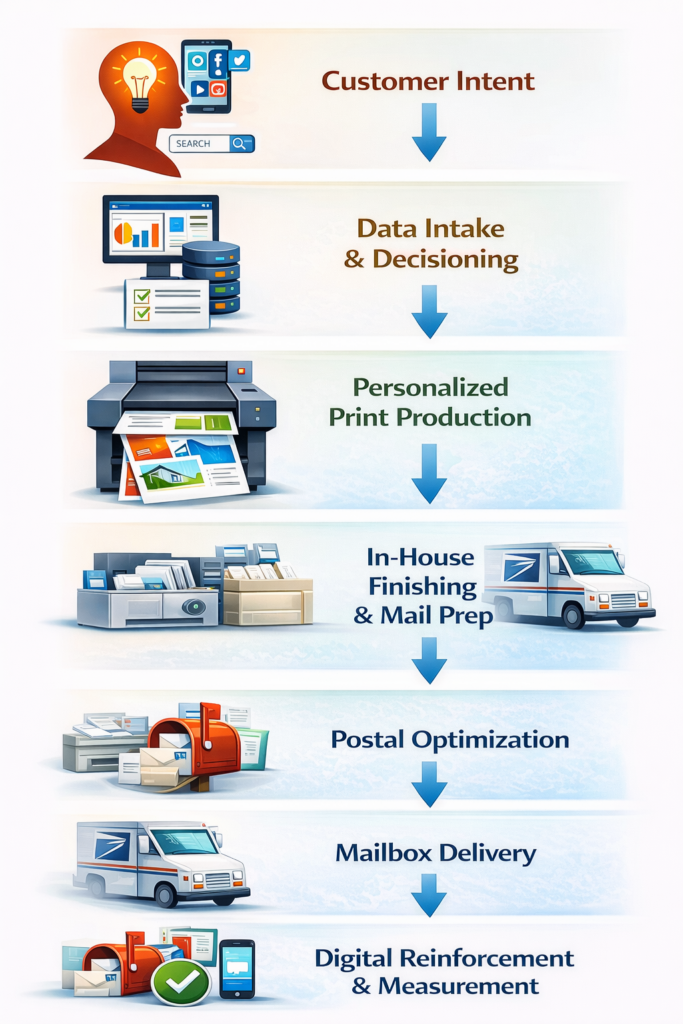
American Litho refers to this structured approach to improving postal strategy and campaign execution as PostEvolution—a methodology focused on analyzing and optimizing every step of the mailstream.
Cross-channel direct mail refers to campaigns where physical mail is coordinated with digital marketing channels such as email, paid media, and web engagement. Instead of operating independently, each channel reinforces the others, creating a connected customer journey that increases engagement and conversion.
Modern buying decisions often happen quickly. When a prospect shows interest—by visiting a website, downloading content, or researching a product—responding while that intent is still active can significantly improve conversion rates. High-speed production environments allow direct mail to reach the mailbox while that decision window is still open.
Modern buying decisions often happen quickly. When a prospect shows interest—by visiting a website, downloading content, or researching a product—responding while that intent is still active can significantly improve conversion rates. High-speed production environments allow direct mail to reach the mailbox while that decision window is still open.
Executing triggered direct mail campaigns requires daily data intake, high-speed personalized print production, in-house finishing and mail preparation, and integrated postal optimization. Without these capabilities working together, campaigns often lose speed and coordination.
Modern campaigns track engagement across both physical and digital channels. Mail delivery data, QR scans, website visits, and digital interactions can all be connected to measure response and optimize future campaigns.

Cross-channel direct mail is a performance-driven marketing strategy in which physical mail is fully integrated with digital engagement channels — including web, CRM, email, paid media, and marketing automation — to create coordinated, measurable customer journeys.
It is not simply “direct mail plus digital.” It is a unified execution model.
In today’s compressed buying environment, prospects move fluidly between devices, platforms, and physical touchpoints before making decisions. A buyer may research online, compare competitors, download content, receive a personalized mailpiece, scan a QR code, and convert digitally — often within days.
Cross-channel direct mail is engineered to mirror this behavior.
Rather than operating in silos, data signals from digital engagement flow directly into production. Personalized mail is triggered and deployed quickly. Digital channels reinforce messaging during the in-home window. Attribution spans both physical and digital response.
The result is coordinated engagement instead of isolated touches.
However, true cross-channel execution requires more than marketing strategy. It requires operational infrastructure.
Most providers rely on fragmented production models, where data, printing, finishing, mailing, and digital integration occur across separate vendors. Each handoff introduces friction. Speed suffers. Intent fades.
At American Litho, cross-channel direct mail is supported by infrastructure built for velocity. Through PostEvolution — our methodology for optimizing postal strategy and production workflow — campaigns are engineered from the outset to minimize delay and maximize in-home timing precision.
Simultaneously, Amerlytics provides dashboard visibility across data intake, production status, postal routing, and delivery windows — ensuring that cross-channel performance is measurable and predictable.
Cross-channel direct mail is not a creative tactic. It is an execution discipline.
When engineered correctly, direct mail becomes the physical anchor of omnichannel strategy — activating coordinated digital reinforcement and delivering measurable business outcomes across every channel.
Direct mail integrates with digital marketing through shared data architecture, synchronized timing, and unified attribution.
The integration begins with intent.
Website engagement, CRM activity, product comparison behavior, and content downloads generate actionable data signals. When infrastructure supports daily data intake and automated decisioning, those signals can trigger personalized mail production in near real time.
From there, integration continues across multiple layers:
1. Trigger-Based Production
Digital behavior activates physical mail deployment.
2. Personalized URLs (PURLs) and QR Codes
Mail connects directly to trackable digital destinations.
3. Coordinated Digital Reinforcement
Email, paid media, and retargeting align with in-home timing.
4. Unified Attribution
Engagement is measured across physical and digital touchpoints.
Timing is critical. Digital reinforcement is most effective when it coincides with the in-home delivery window. This requires postal intelligence to be embedded early — not layered in after creative is finalized.
Through PostEvolution, American Litho integrates postal optimization into campaign architecture from day one. Mail class selection, drop timing, routing strategies, and commingling decisions are aligned with digital cadence.
Amerlytics then provides operational visibility — enabling marketers to track production velocity, postal processing, in-home projections, and downstream engagement signals in one unified environment.
When direct mail and digital channels operate within the same execution framework, mail becomes a physical trigger that amplifies digital performance.
Instead of competing for attention, channels reinforce one another.
The result is stronger recall, improved response rates, and higher conversion efficiency — driven by coordination rather than coincidence.
Speed to mailbox matters because buyer intent has a short half-life.
Modern prospects research quickly, compare aggressively, and decide rapidly. Delayed follow-up erodes opportunity. If a triggered mailpiece arrives weeks after digital engagement, intent has often dissipated — and conversion probability declines.
Speed to mailbox is now as critical as speed to inbox.
In performance marketing environments — particularly in healthcare, financial services, insurance, and high-volume direct marketing — responsiveness directly influences ROI.
Fast execution drives:
• Higher response rates
• Lower cost per acquisition
• Improved cross-channel lift
• Increased campaign efficiency
However, speed is not achieved through urgency alone. It requires structural capability.
Daily data intake. Automated workflow. High-speed personalization. In-house finishing. Embedded postal intelligence. Production visibility.
When these capabilities are fragmented across vendors, campaign velocity slows. Production queues stack. Postal decisions are reactive. Intent windows close.
Through PostEvolution, American Litho optimizes workflow sequencing, postal routing, and production velocity to reduce time from signal to mailbox.
Amerlytics provides real-time visibility into production milestones and projected in-home delivery, enabling digital reinforcement to align precisely with physical arrival.
The brands that convert most effectively are those that act while intent is active — not weeks later.
Speed to mailbox is no longer operational convenience. It is competitive advantage.
Triggered direct mail demands more than marketing automation. It requires integrated operational infrastructure capable of executing at speed and scale.
Five capabilities must exist simultaneously:
1. Daily Data Intake and Decisioning
Behavioral signals must be processed continuously — not in weekly batches.
2. High-Speed Personalization at Scale
Variable content, data-driven creative, and dynamic formatting must be executed efficiently across large volumes.
3. In-House Finishing and Mail Preparation
Outsourced finishing introduces delay. Integrated production preserves velocity.
4. Postal Intelligence Embedded Early
Mail class, workshare optimization, drop timing, and routing strategies must be built into campaign design.
5. Visibility from Production Through Delivery and Response
Marketers require operational transparency and performance measurement.
Most direct mail providers operate in fragmented models where these capabilities live in separate systems. Each transition introduces time, risk, and coordination breakdown.
Triggered direct mail cannot be bolted onto legacy workflows.
At American Litho, infrastructure is engineered to support real-time execution. PostEvolution ensures postal strategy and production sequencing are aligned from campaign inception. Amerlytics delivers dashboard-level visibility into workflow progression, delivery projections, and engagement outcomes.
Triggered direct mail is not simply “fast printing.” It is synchronized execution across data, production, postal strategy, and digital reinforcement.
Without infrastructure, triggers stall.
With infrastructure, triggers convert.
Omnichannel campaign performance is measured by analyzing coordinated engagement across physical and digital channels within a unified attribution framework.
Traditional reporting isolates metrics — mail response, email opens, digital clicks — without recognizing their interdependence.
Cross-channel performance measurement evaluates:
• In-home delivery timing
• QR code and PURL engagement
• Website activity following mail receipt
• Assisted conversions
• Control group lift
• Cost per acquisition (CPA)
• Return on marketing investment (ROMI)
When engagement signals are unified, marketers can determine how direct mail influences digital behavior — and how digital reinforcement amplifies physical response.
Timing analysis is particularly critical. Performance frequently spikes during the in-home window when mail and digital reinforcement overlap.
Amerlytics provides operational and performance visibility — allowing marketers to correlate production timing, delivery projections, and engagement data within a single reporting framework.
PostEvolution enhances measurement by optimizing postal execution in ways that reduce variability and increase predictability.
The objective is not simply tracking response. It is engineering campaigns so that response becomes consistent, repeatable, and scalable.
Omnichannel performance is strongest when:
• Infrastructure supports speed
• Postal strategy supports timing
• Data supports personalization
• Channels reinforce one another
Measurement, therefore, is not retrospective reporting. It is continuous optimization.
When execution is connected, performance becomes predictable.
"*" indicates required fields